
Goodbye, Springs.
Hello, Gas.
Windgap’s gas-powered technology replaces spring mechanics with tuned precision— delivering faster, easier, and more reliable mixing and delivery for modern complex injectables.
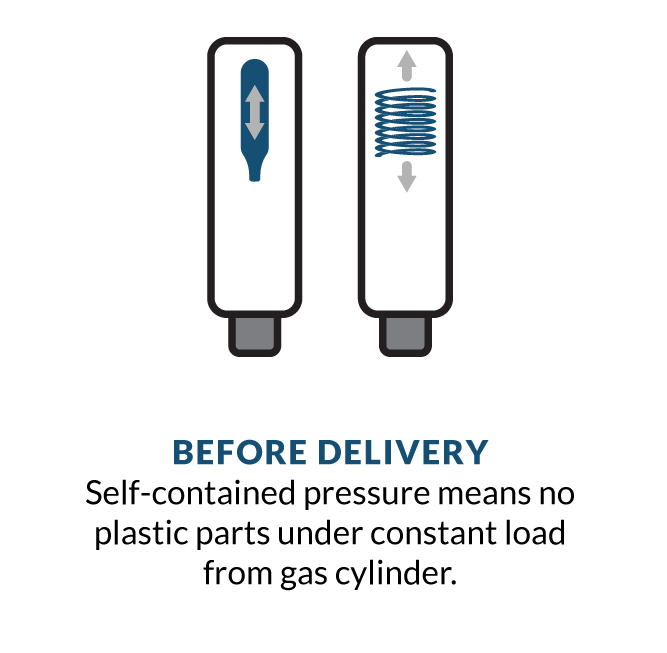
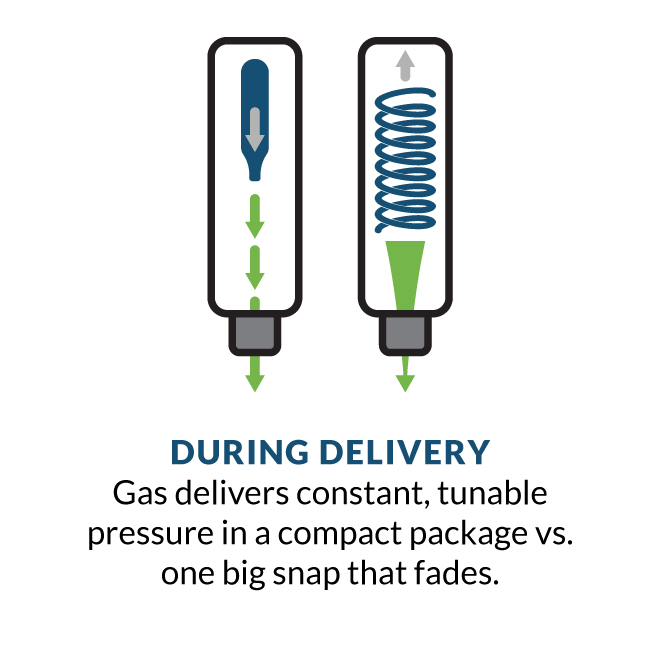
Are Springs Slowing the Science?
Designed for simpler therapies, spring-based autoinjectors struggle with evolving viscosities and dose volumes. To compensate, they often require additional steps, shaking, and formulation workarounds—slowing down development and complicating delivery.
Modern therapies—and today’s patients—can’t wait. Now, they don’t have to.
Gas: A Powerful Mix of Benefits
Faster, Smoother Mixing
Gas-powered systems drive reciprocating flow, thoroughly combining therapies in seconds—without shaking, swirling, or tapping.
Finely Tuned
Precision
Unlike springs, gas enables tuned pressure profiles, customized for even the most complex therapies.
Greater
Flexibility
A tiny cylinder delivers a sustained force for high-viscosity biologics, large volumes, and sequential dosing strategies.
Better Patient Experience
Quiet, consistent delivery reduces variability and risk—supporting improved patient adherence and comfort.
Robust Results
<18 sec
75cP Suspension,
Mixed and Delivered
Variable Viscosity. Consistent Reliability.
Windgap’s gas-powered system is designed to handle both low (1 cP) and high (5000+ cP) viscosities, with moderate viscosities delivered in <10 seconds.
99%
Reduction
in Administration Time
Faster, Smoother Administration
In one feasibility study, MultiMix reduced preparation and injection time from 2 hours to under 60 seconds—a breakthrough in patient and provider efficiency.
-2
Reduction in Needle Size for High-Viscosity Therapies
Smaller Needles = Less Pain. More Patient Gains.
No more 18G needles. Windgap’s gas-powered technology enables uniform mixing and efficient injection, delivering high-viscosity suspensions (75+ cP) smoothly through smaller, patient-friendly 23–29G needles — in under 15 seconds.
Frequently Asked Questions
-
It comes down to mechanics—and the demands of evolving therapies.
Springs can deliver powerful bursts of force and have served simpler therapies well. But for today’s high-viscosity, large-volume, or sensitive biologics, their limitations quickly show. A spring’s one-directional burst is hard to control and nearly impossible to recapture, which makes reciprocation cycles—essential for thorough reconstitution—almost unattainable. To generate enough energy for thicker formulations, springs would need to be prohibitively large, adding bulk and complexity to the device.
Gas, by contrast, packs higher energy density into a compact form and delivers it as a controlled, sustained pressure profile. This continuous, bidirectional force enables repeatable reciprocation between cartridges, precise control over flow rates, and a wider range of injection strategies. The result: consistent reconstitution, efficient delivery, and the ability to handle complex therapies in smaller, more user-friendly devices.
Explore Windgap’s entire gas-powered line-up here.
-
Many biologics and suspensions are highly shear-sensitive—too much force can denature proteins or shear apart fragile molecules, rendering the therapy less effective. Instead of being locked into a single high-force “snap” of a spring, gas-powered systems can be tuned to move plungers quickly when speed is needed, or glide gently to reduce shear forces. This tunability enables the design of an ideal force profile for each drug, ensuring stability during reconstitution and delivery. Reciprocated flow further preserves molecular integrity, giving sensitive therapies the protection springs often can’t.
Explore the Windgap platforms.
-
Different gases expand at different rates and pressures. Windgap’s devices can be engineered with tailored force curves—gentle for delicate proteins, stronger for high-viscosity suspensions. Because the device is pre-set during manufacturing, every device ships with the optimal pressure profile for its specific therapy. The patient never has to adjust anything; the performance is built-in.
Every Windgap platform can be customized to your therapy—and your patient experience. Learn more here.
-
Suspensions are notoriously difficult to deliver because shaking often leaves clumps or uneven dispersion, creating blockages that demand larger-gauge needles (e.g., 22G). Gas-powered reciprocation creates uniform, fully dispersed suspensions, reducing localized viscosity across the dose. This consistency makes it possible to deliver even high-viscosity suspensions (>75 cP) through smaller 29G needles—minimizing pain, improving patient tolerance, and doing so without extending injection times.
Find out what Windgap platform can fit the needs of your therapy—and your patient—here.
-
Yes! Sequential delivery often requires multiple injections or complex mechanical steps when using traditional spring-based devices. Gas-powered systems enable precise, bidirectional control over fluid flow, making it possible to deliver two therapies through a single needle in a validated sequence. The sustained, programmable pressure profile ensures that each dose is delivered accurately and in the correct order—without adding complexity for the user.
Explore DualFlo’s sequential and large-volume delivery platform here.
-
Delivering two liquid doses or a large combined volume requires high force and fine control. Springs can provide one or the other—not both—without becoming bulky and difficult to manage. Gas, by contrast, packs high energy density into a compact form and maintains consistent pressure across the entire injection, even for high-viscosity or high-volume therapies. This allows sequential or large-volume injections to happen smoothly and quickly, using a single device and a single injection.
Explore DualFlo’s sequential and large-volume delivery platform here.
-
Gas-powered delivery compresses the administration of complex drugs into a single, simple, and smooth process—whether you are delivering two sequential medicines, a large volume dose, or a mixed therapy. Among other things, it means simpler steps, no shaking, and faster injections. Quiet, controlled pressure reduces variability across users, while smaller needles make injections more tolerable. The result: improved adherence, better comfort, and more consistent outcomes for patients—and less training and fewer errors for providers.
Explore our product platforms here.
Design and deliver—without the detours.
From rapid reconstitution to dual-drug delivery, our platform evolves with your pipeline.
Each Windgap platform shares a modular architecture and customizable components, so we can help you get to market faster with fewer formulation trade-offs.
ONEMIX
The Instant Solution™ for highly soluble lyophilized drugs, designed with an easy two-step delivery.
DualFlo
Two liquid doses. One simple injection. Ideal for large volumes or drugs that can’t be co-formulated.
MULTIMIX
The go-to for difficult-to-mix biologics, suspensions, and lyophilized drugs